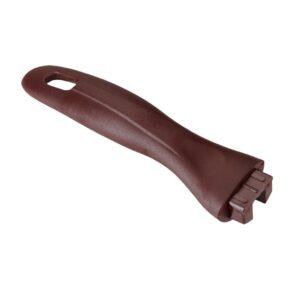
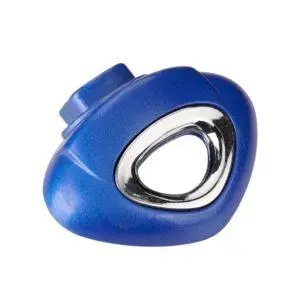
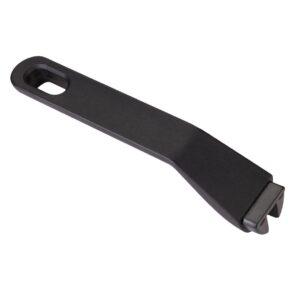
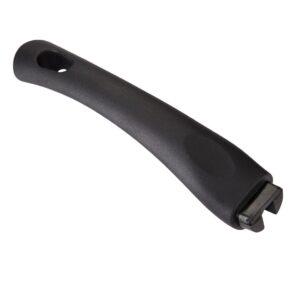
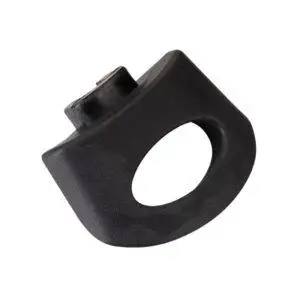
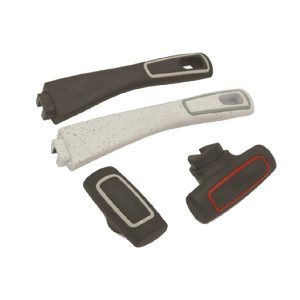
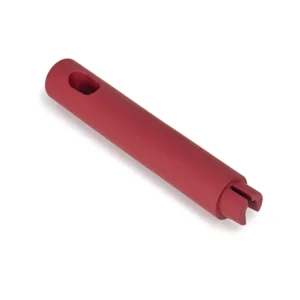
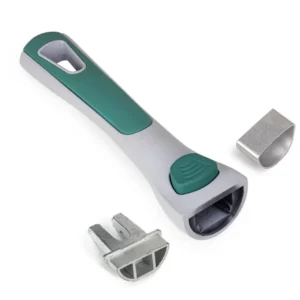
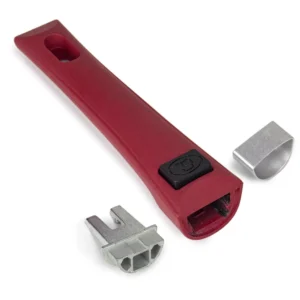
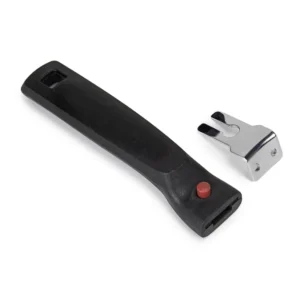
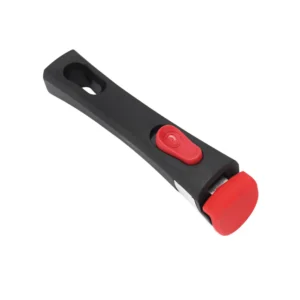
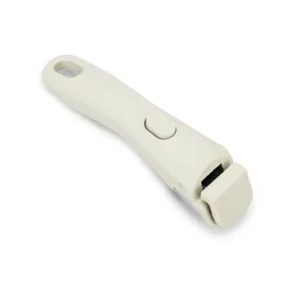
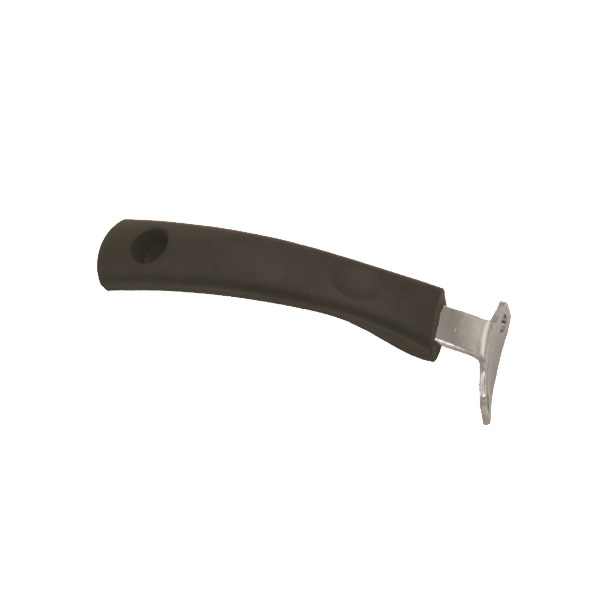
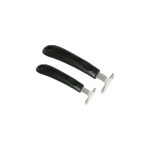
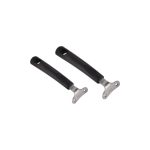
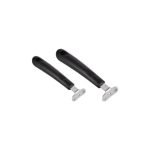
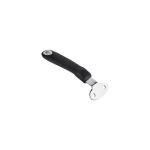
 Bakelite handle Manufacturer in China

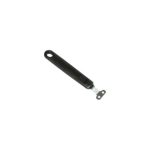
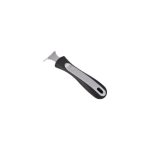
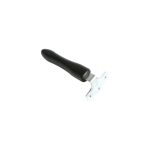
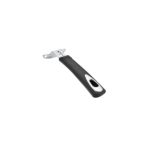
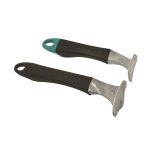
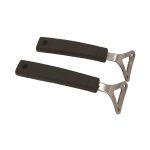
Specifications
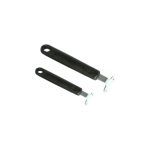
- SIZE: 150mm–200mm
- WEIGHT: 100g–200g
- MATERIALS: Phenolic Resin (Bakelite), PF 42 grade + ductile iron or AISI 304 SS bar
- APPLICATION: Cookware handles — fry pan, saucepan, stockpot, braiser
- Mounting Type: Insert-molded (iron bar embedded during injection molding)
- Insert Options: Iron bar (standard), AISI 304 SS bar (premium)
- Color: Black, brown, grey; custom RAL/Pantone available
- Heat Resistance: 180°C continuous; peak 220°C
Why Bakelite Handle with Iron Bar Uses Insert-Molded Engineering
A bakelite handle with iron bar uses insert molding — the iron bar is placed in the mold and Bakelite is injected around it, creating a molecular bond at the interface. This is not a mechanical press-fit or snap-fit. Budget handles use separate mounting brackets that loosen over time.
We specify insert molding for permanent reinforcement. The iron bar carries all structural load while Bakelite provides the grip surface and heat resistance. This eliminates the threaded insert failures that plague press-fit constructions.
The 4-Point Bakelite Handle with Iron Bar Engineering Checklist
1. Insert Molding — Demand Molded-In Place, Not Press-Fit
Press-fit iron bars separate under thermal cycling. We use insert molding where the iron bar is placed in the mold and Bakelite is injected around it at 180–200°C. This creates a molecular bond at the interface that survives 2,000 thermal cycles.
2. Iron Bar Material — Demand Ductile Iron, Not Mild Steel
Mild steel bends under load. We specify ductile iron for the embedded bar — it has ≥400 MPa tensile strength and absorbs impact without fracturing. Mild steel cracks at stress concentrations near the mold cavity.
3. Insert Pull-Out Force — Demand ≥350 N
We specify minimum 350 N pull-out force for the insert-to-Bakelite interface, confirmed per production lot. Budget press-fit handles fail at <200 N after thermal cycling.
4. Bar Length and Positioning — Demand Cpk ≥ 1.33
We maintain Cpk ≥ 1.33 on bar length and insert positioning to ensure consistent molded-in-place strength. This ensures interchangeability across production batches.
Insert-Molded vs. Press-Fit: Performance Comparison
| Performance Metric | Press-Fit Iron Bar | Insert-Molded (Birss) |
|---|---|---|
| Interface bond | Mechanical friction | Molecular (Bakelite flows around bar) |
| Pull-out force | <200 N (degrades over time) | ≥350 N (stable) |
| Thermal cycling | 200–500 cycles before loosening | 2,000+ cycles |
| Failure mode | Bar separates from Bakelite | None — permanent bond |
| Mounting | Separate bracket required | Integral (no extra hardware) |
Consequently: insert molding is the engineering-correct solution for Bakelite handle reinforcement.