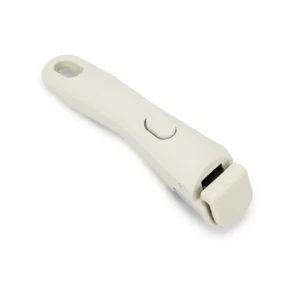
Bakelite handle Manufacturer in China


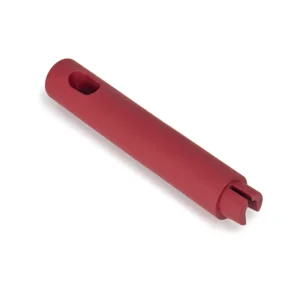
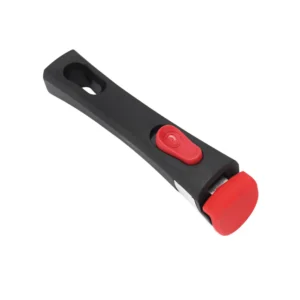
Casserole side handles are lifted by two hands while the dish is full, so the pair is rated 160–180°C continuous, with 200–220°C on modified grades. More orders are lost to colour drift than to heat, which is why the colour reference is signed and written into the PO before the first press run.
What makes a casserole side handle different?
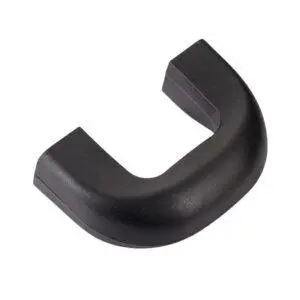
Two figures set the casserole ear apart: a 160–180°C continuous rating and a 200–220°C ceiling on modified grades, with a wide ear body that takes the weight of a deep, full dish. A cast Dutch oven stores heat in the wall, so the ear sees a steady soak instead of a short spike, and the seat is drawn longer than on a sauce pot so the load spreads across the whole ear.
The lift is also different: a casserole is carried level with both hands, which puts a bending load on the ear rather than a straight pull. A deeper seat keeps that bend out of the fixing hole.
Which casserole and Dutch-oven bodies fit?
Fit is quoted from 2 drawings: the ear position on the body and the fixing hole, and one 2,000 pcs run holds both. Round and oval bodies, cast and pressed, deep and shallow, are all handled the same way: the body section sets the seat curve, and the wall thickness at the fixing sets the boss depth.
Send a sketch or one sample dish and the ear is matched to the rim height, so a lid still closes with the handles fitted.
Technical specifications
The table lists what a 2,000 pcs casserole handle order carries, including the 160–180°C continuous rating, the 200–220°C modified-grade limit and the 20–25 day container lead time.
| Property | Value |
|---|---|
| Material | Phenolic resin, PF2A2 or PF2A4-151J |
| Continuous heat | 160–180°C |
| Modified grade heat | 200–220°C |
| Forming | Compression moulded in a heated press |
| Ear body | Wide ear with a long seat for a deep bowl |
| Fixing | Screw and washer, moulded boss, or rivet |
| Colour | Pantone code written into the PO |
| Batch check | 3% AQL on every lot |
| MOQ | 2,000 pcs |
| Lead time | 20–25 days for a full 20GP container quantity |
| Test standard | EN 12983-1:2023 |
How is colour kept consistent across shipments?
Colour is fixed by a Pantone code written into the PO, and each batch is checked at 3% AQL before it ships. Both sides sign a physical colour sample before the first run, so the reference is a moulded part rather than a screen value or a memory of the last shipment.
- Pantone code written into the purchase order.
- Signed colour sample held as the master for every repeat.
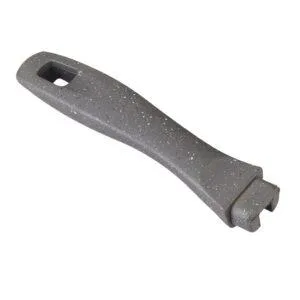
- Resin pigmented before pressing for a through colour.
- Sprayed finish where a two-tone line needs it.
- 3% AQL check on each batch before packing.
How is a casserole handle made and checked?
Every lot runs on 20+ compression presses with a combined 70,000 pcs/day, and the five checkpoints below are logged per batch.
- Weigh the PF2A2 or PF2A4-151J charge for the ear size.
- Preheat the charge and load it into the steel cavity.
- Close the press and hold until the ear section cures through.
- Deflash the parting line and dress the seat that meets the bowl.
- Check ear position, seat curve and colour against the drawing, the signed sample and EN 12983-1:2023.
Is a stainless steel version available?
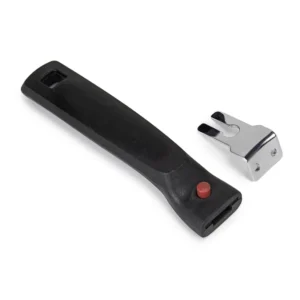
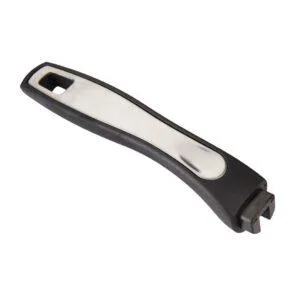
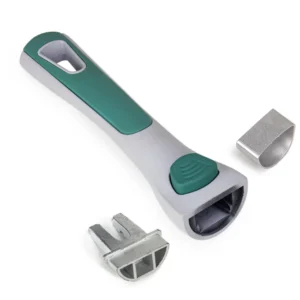
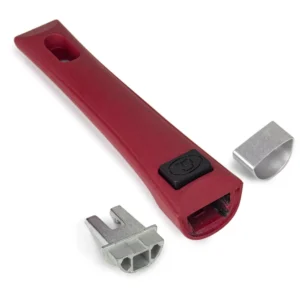
Both materials are quoted at 2,000 pcs on the same mounting centres, so one pot wall can carry either ear without a tooling change. A stainless ear is the option when a cookware line wants a different look on the same body, and it is specified against the same drawing as the phenolic part.
Frequently asked questions
Four questions come back before most 2,000 pcs casserole handle orders are released.
Will the ear fit an oval casserole?
An oval body needs 2 fixing points, and a 2,000 pcs run holds both positions while the seat is drawn from the body section. Send the oval in a top view and the ear is set on the long axis, where the wall is stiffest.
How hot does the ear get in the oven?
The standard grade holds 160–180°C and the 200–220°C ceiling belongs to the modified grade, so an oven bake above 180°C is quoted in the modified resin. Tell your end user which grade the ear is made from rather than implying it can take any oven setting.
Can I see a sample before the 2,000 pcs run?
A sample pack ships before the 2,000 pcs run and a quote follows within 1 working day of your sketch. Your QC team can check the seat on a real dish before the tool is committed.
What are the order terms?
MOQ is 2,000 pcs, and a full 20GP container quantity runs 20–25 days after the colour sample is signed. Repeat lots are pressed on the same cavity with the same Pantone reference.
Key takeaways
- 160–180°C continuous, with 200–220°C on modified grades, moulded in PF2A2 or PF2A4-151J.
- Pantone code in the PO, signed sample on file and a 3% AQL check on every batch.
- 2,000 pcs MOQ, 20–25 days per 20GP container, stainless available on the same centres.
Orders start at 2,000 pcs, and a full 20GP container quantity runs 20–25 days. The colour reference and the seat curve are agreed on a physical sample first, then the run is pressed against both.
Related parts: cookware ear handles, dual side handles for pots, pot side handles, heat-resistant side handles, bakelite side handle, and the full bakelite side handle range.
Send the dish sketch, the rim height and your Pantone reference to sales@bshouseware.com and we return the sample date.